Downloads

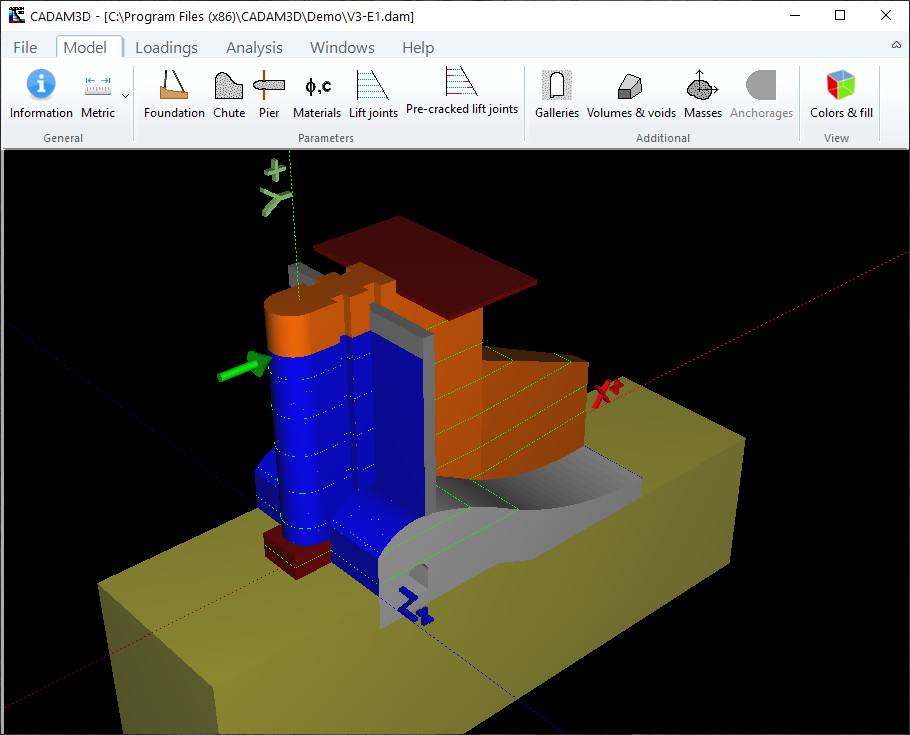
CADAM3D is a user-friendly software based on the gravity method originally developed for one of the world biggest concrete dam owner, Hydro-Quebec, and for Dams and Hydrology of the Quebec Ministry of Environment (Quebec's legislator for dam safety). CADAM3D is fully functional and is intensively used by Hydro-Quebec since 2005. To our knowledge, no other software similar to CADAM3D is available at this time.
If you perform stability analyzes of concrete hydraulic structures, this software will allow you to perform them much faster and more efficiently. If you are interested in this type of software and would like to try CADAM3D for free, please click on the button "Contact us for a free trial of CADAM3D" to send us a message.
: Provides a preview and links to official retailers like Google Play. Editorial Limusa
Este volumen trasciende la descripción física y de laboratorio del Tomo 1. Se adentra por completo en el comportamiento matemático, teórico y práctico del suelo bajo cargas mecánicas e hidráulicas. Estructura y Contenido Clave del Tomo 2
Mecánica de Suelos Juárez Badillo Tomo 2: Teoría y Aplicaciones Fundamentales
Es el libro de texto principal en cursos avanzados de Ingeniería Geotécnica. Alternativas y dónde conseguirlo
4. Lateral Earth Pressure: Rankine and Coulomb theories, specifically tailored for retaining walls in Mexican volcanic soils. 5. Stability of Slopes: Circular failure surfaces, the Swedish method (Fellenius), Bishop’s method, and analysis of infinite slopes. 6. Bearing Capacity: Terzaghi’s, Meyerhof’s, and Vesic’s theories for shallow foundations. 7. Deep Foundations: Pile design (friction and end-bearing), negative skin friction, and pile groups. 8. Settlement Analysis: Immediate and consolidation settlements in granular and cohesive soils. mecanica de suelos juarez badillo tomo 2pdf work
Alternativa para suelos estratificados o con anisotropía marcada.
Basic principles for the design, seepage analysis, and construction of soil-based dams.
To demonstrate the aspect, here is a condensed problem typical of Juárez Badillo – Tomo 2, Chapter 15:
Permite localizar al instante ecuaciones específicas (como los factores de influencia de Newmark) sin necesidad de hojear cientos de páginas físicas. : Provides a preview and links to official
Basic principles for the design and construction of embankments and earthen dams.
If you are a Civil Engineering student or a professional working in a Spanish-speaking country, this is likely the "Bible" for your geotechnical courses. It is not an easy read—it demands mathematical discipline—but it provides a depth of understanding that modern simplified textbooks often lack.
Para que el uso de este material digital sea eficiente en tus proyectos de ingeniería, te recomendamos seguir esta metodología de aplicación:
La mecánica de suelos es una rama fundamental de la ingeniería civil que se enfoca en el estudio del comportamiento de los suelos y sus propiedades físicas y mecánicas. Esta disciplina es crucial en la planificación, diseño y construcción de obras civiles, ya que permite a los ingenieros predecir y prevenir problemas relacionados con la estabilidad y la seguridad de las estructuras. En este sentido, el libro "Mecánica de Suelos" de Juárez Badillo es una referencia clásica y ampliamente utilizada en la formación de ingenieros civiles. Estructura y Contenido Clave del Tomo 2 Mecánica
For those seeking a digital copy for academic "work" or study, the book is frequently available on educational repositories and library databases.
Muchos estudiantes y profesionales buscan la versión digital (PDF) por su portabilidad. Sin embargo, contar con la edición física facilita la consulta de gráficas y ábacos de diseño que son fundamentales para los cálculos manuales. El "work" o solucionario adjunto suele ser la herramienta más buscada para verificar procedimientos matemáticos complejos. Impacto en la Ingeniería Moderna
The book is structured to guide the reader from fundamental soil behaviors to the design of major engineering projects. The following chapters are based on official descriptions from publishers and detailed book listings:
Fundamentos y Aplicaciones del Tomo 2 de Mecánica de Suelos de Juárez Badillo y Rico Rodríguez
On the Digital Life of a Classic: Working with Juárez Badillo, Tomo 2 (PDF)
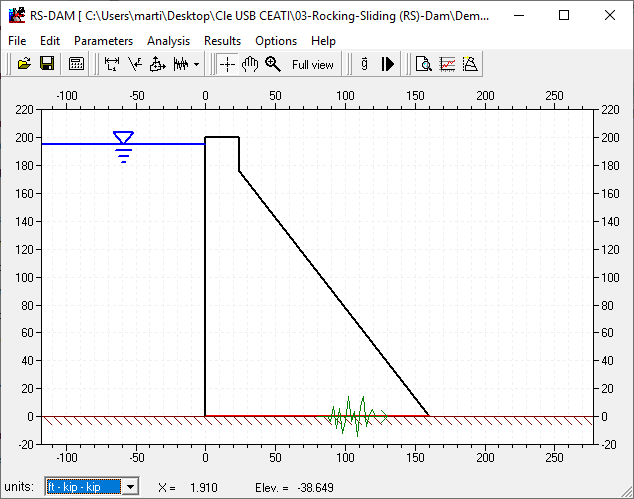
RS-DAM is a computer program that was primarily designed to provide a computational tool to evaluate the transient response of a completely cracked concrete dam section subjected to seismic loads. RS-DAM is also used to support research and development on structural behavior and safety of concrete dams.
RS-DAM is based on rigid body dynamic equilibrium. It performs a transient rocking and/or sliding analysis of a cracked dam section subjected to either base accelerations or time varying forces. Several modelling options have been included to allow users to explore the influence of parameters (e.g. geometry, additional masses, variation of the uplift force upon rotation, hydrodynamic pressures in translation (Westergaard) and rotation, center of rotation moving with sliding, coefficient of restitution of impact, etc...). RS-DAM is developed in a university context and has no commercial aspect.
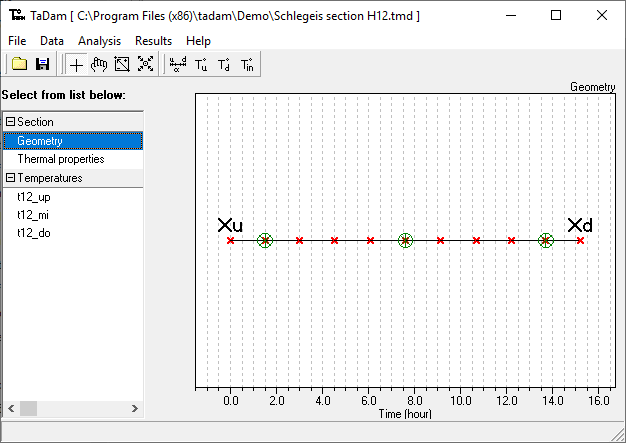
TADAM (Thermal Analysis of concrete DAMs) software employs a new frequency-domain solution technique to solve the 1D thermal transfer problem, allowing the calculation of temperature histories in a concrete dam section.
The direct solution calculates the evolution of the temperature distributions from the temperature histories of the upstream and downstream faces. The inverse solution uses temperature histories, measured inside the section, in order to calculate the temperature fields at the external faces, while taking into account the thermal wave attenuation effects and the phase angles along the section.
TADAM is developed in a university context and has no commercial aspect.