or, install from WinGet:
C:\> winget install KirillOsenkov.MSBuildStructuredLogViewer
C:\> choco install msbuild-structured-log-viewer
You can produce binary logs from the dotnet build command by passing the -bl argument:
Pass /bl to record all build events to a binary log file:

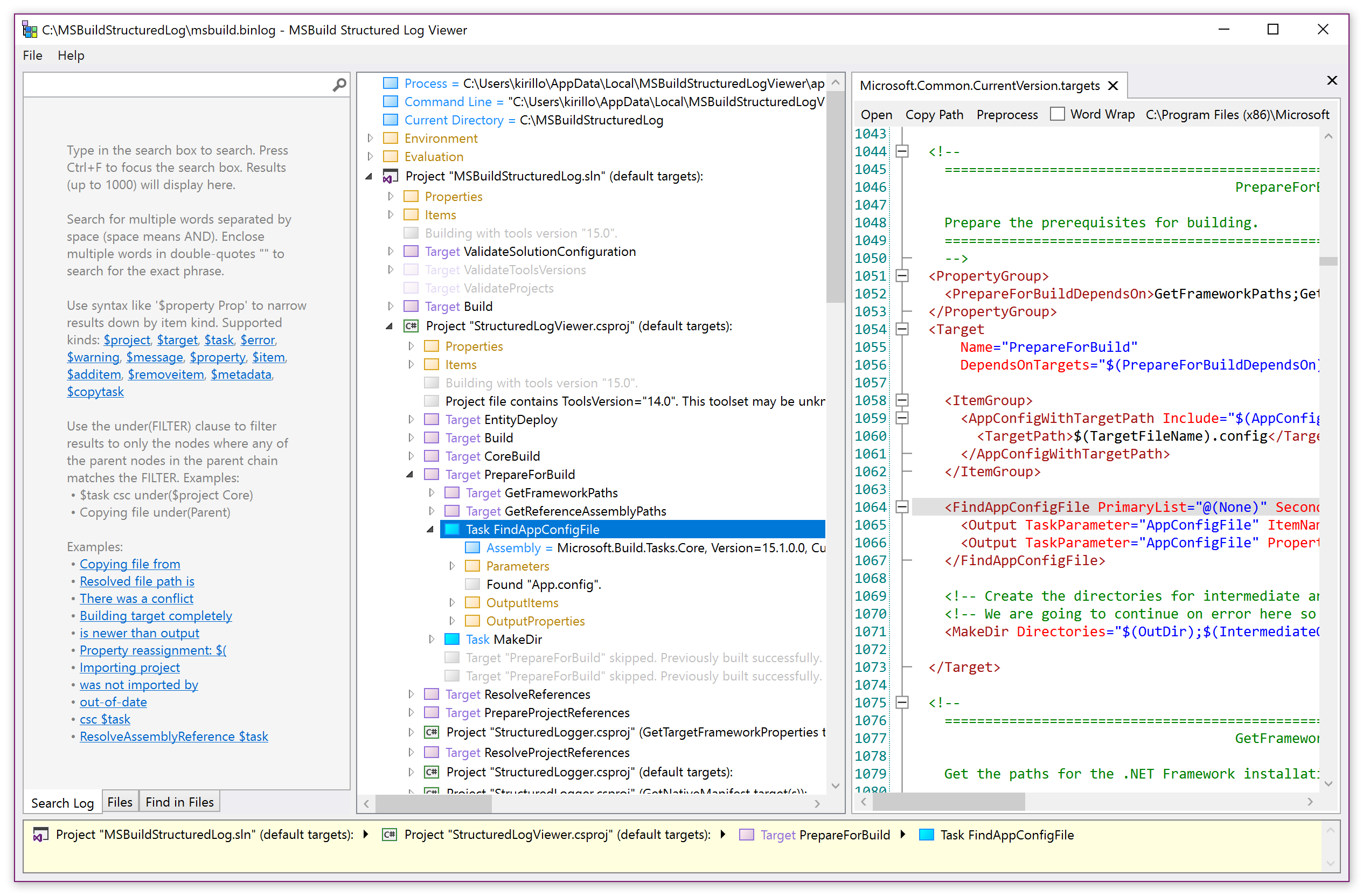
Double-click the .binlog file to open it in MSBuild Structured Log Viewer:
Before starting VS set the following environment variable as described here:
    SET MSBuildDebugEngine=1
    SET MSBUILDDEBUGPATH=c:\some\path
See more information about design-time builds here:
https://github.com/dotnet/project-system/blob/master/docs/design-time-builds.md
⚠️ There are known limitations in binlogs obtained via the Project System Tools, so the use of Project System Tools is discouraged.
You can pass a .binlog file to MSBuild instead of a project/solution to replay it to other loggers, as if a real build was happening. This allows you to reconstruct a text log of any verbosity given the .binlog file. Read more at: https://github.com/Microsoft/msbuild/wiki/Binary-Log#replaying-a-binary-log
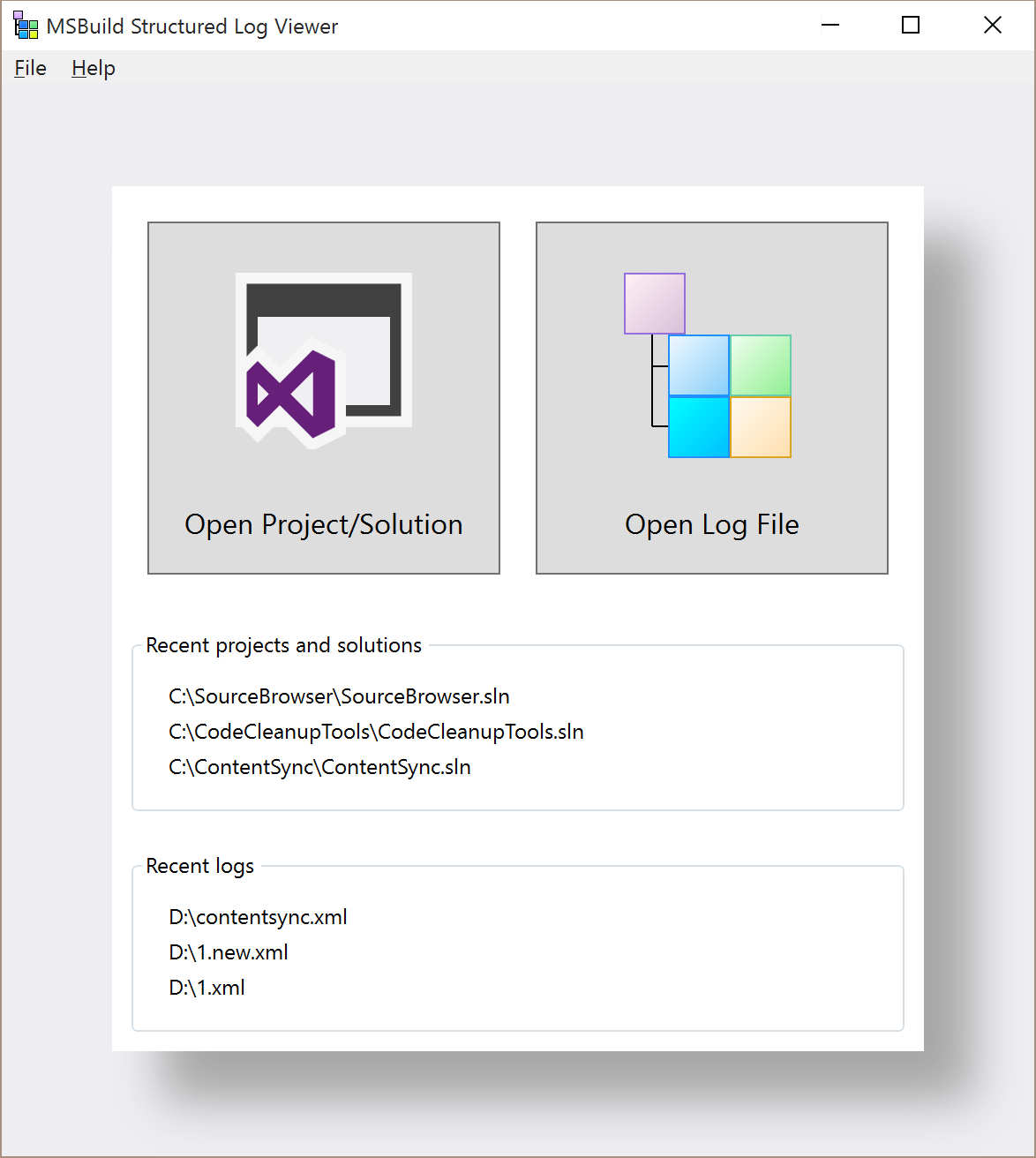
The MSBuild Structured Log Viewer can build projects and solutions or open existing log files:
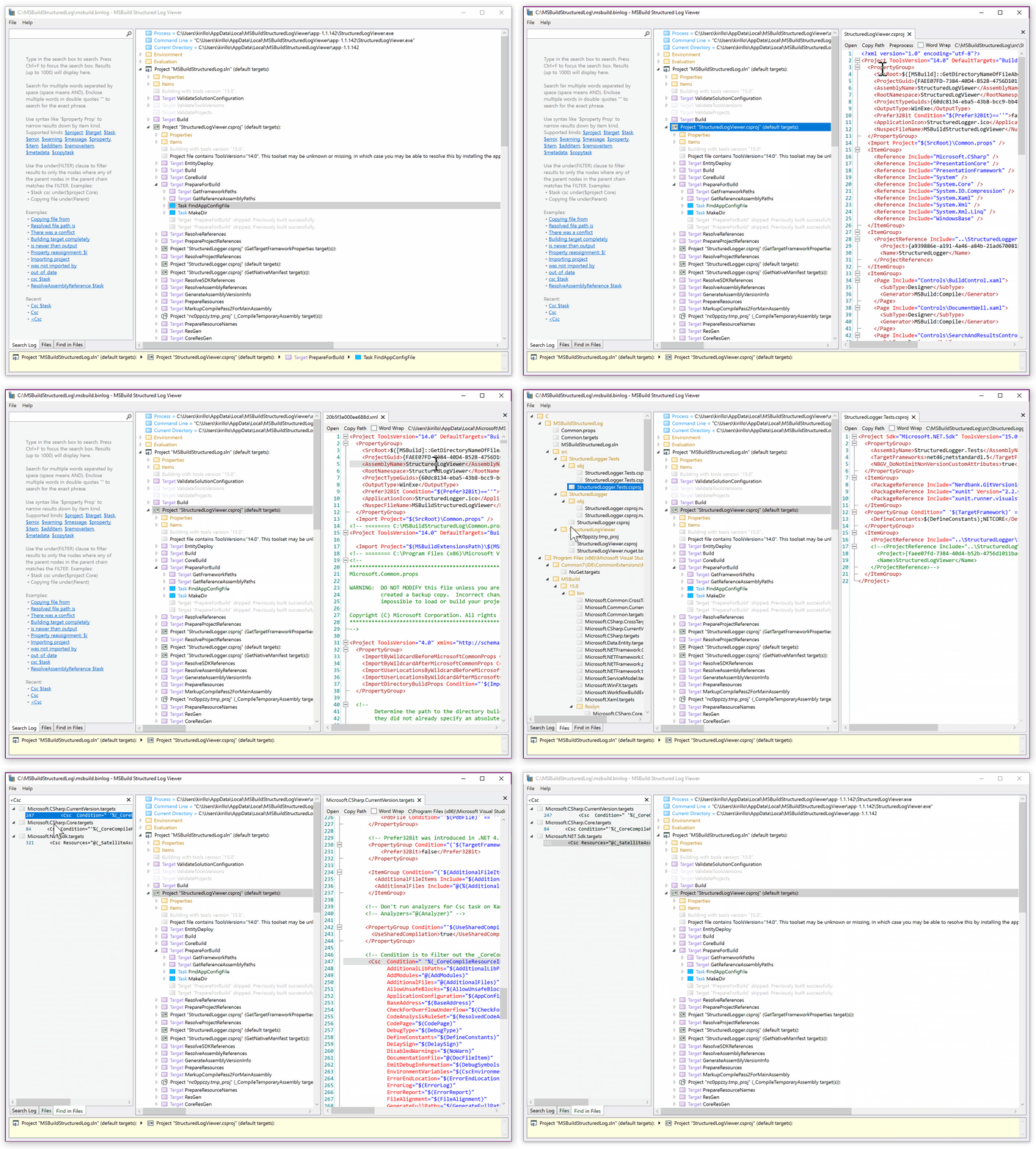
Leverage the source code of projects and targets embedded in the log file:
The viewer supports two file formats:
The viewer can read all formats and can save to *.xml.
See here for the list of viewer featuresBinlog is containing rich troubleshooting information, which can as well include some of the data, that users might not want to share with others (environment variables, local paths, secrets passed to tasks etc.) To allow sharing of such binlogs Viewer offers option to redact data from binlog under File -> Redact menu:
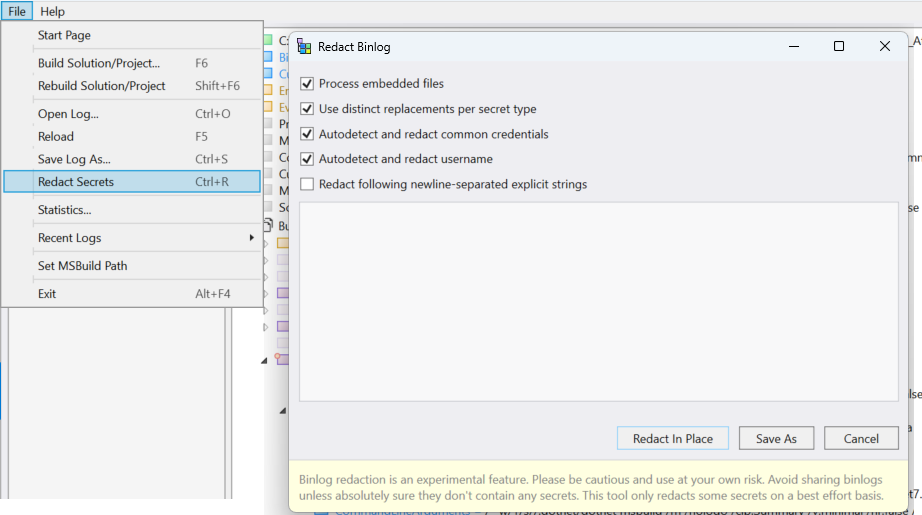
Note that the autodetection option is currently supporting only a very limited number of patterns (and even after future extensions it can only be considered best-efforts redaction - not an exhaustive one). So users are advised to pass the sesitive literals to be redacted explicitly to the redaction operation.
See MSBuild command-line help msbuild /? for more information on the /bl switch. The switch is available starting with MSBuild 15.3 (Visual Studio 2017 Update 3 or newer).
: Incluye Pokémon de la 1ª a la 8ª generación, formas de Alola y Galar, y megaevoluciones. Mecánicas : Incorpora funciones únicas como , además de Dynamax y Gigamax.
: Único por su modo multijugador y la posibilidad de seguir a los Pokémon fuera de su Pokéball, todo en una versión de Esmeralda expandida. Cómo Randomizar Cualquier ROM de GBA
Pokemon Exceeded no es solo un juego; es prácticamente una plataforma de Pokémon hecha y derecha. Es una de las opciones más completas que existen, ideal para quienes buscan una experiencia absolutamente personalizable.
Esta mecánica es la base de los famosos retos , ideales para quienes buscan una dificultad elevada y una rejugabilidad infinita. Los Mejores Hack ROMs Pokémon GBA en Español y Completos 1. Pokémon Radical Red (Versión en Español)
Uno de los remakes mejor logrados de la segunda generación (Pokémon Oro y Plata) para el motor gráfico de GBA. : Incluye Pokémon de la 1ª a la
Los cambian los Pokémon salvajes, los Pokémon de los entrenadores, los objetos y hasta los movimientos, convirtiendo una aventura conocida en un caos absoluto y divertido.
Es la experiencia definitiva para jugadores competitivos. Cuenta con todas las generaciones (hasta la novena), Megaevoluciones, Movimientos Z y Dinamax.
Conocido por ser uno de los hack roms más difíciles y competitivos. Aunque el original es en inglés, existen versiones traducidas por la comunidad que mantienen todas las funciones de personalización. Randomizer Nativo:
Antes de listar los juegos, aclaremos los términos de búsqueda: Cómo Randomizar Cualquier ROM de GBA Pokemon Exceeded
Basado en una combinación de Esmeralda con el género roguelike, , sino que está estructurado en rutas aleatorias y biomas .
Si eres un amante de la saga Pokémon y has recorrido Kanto, Johto y Hoenn cientos de veces, sabes que llega un momento en que la fórmula clásica se queda corta. Aquí es donde entran en juego las . Pero, ¿qué sucede cuando combinas una región modificada, una historia adulta y la imprevisibilidad de un Randomizer ?
El clásico de los clásicos. Pokémon Rojo Fuego es la base perfecta para iniciarse en el mundo de los aleatorizados. Al estar el juego base 100% traducido de forma oficial, la experiencia en español es impecable.
: Considerado por muchos como uno de los mejores de la historia. Cuenta con una historia original en la región de Borrius, gráficos estilo DS y un modo randomizer interno Los Mejores Hack ROMs Pokémon GBA en Español y Completos 1
Whack a Hack! : La comunidad líder en español para proyectos de ROM hacking.
Estos juegos permiten activar el modo aleatorio desde el menú de opciones interno, facilitando partidas tipo "Randomlocke". Pokémon Last Renoval Red Ultimate
Nunca sabes cuándo una ruta inicial tendrá un Pokémon legendario o un Pokémon con la habilidad Potencia .
: Posee un motor de combate avanzado, una historia totalmente original en la región de Borrius y un menú de configuración inicial
The built-in /bl switch was only introduced in MSBuild 15.3 (Visual Studio 2017 Update 3). However there is a way to record a binary log with previous versions of MSBuild as well. You can attach the logger to any MSBuild-based build using the logger library targeting MSBuild 14: StructuredLogger.dll. It is available in a NuGet package:
MSBuild.StructuredLogger.net45Or you could download it directly here: https://msbuildlog.com/net45/StructuredLogger.dll
Use a command-line such as this to pass the BinaryLogger to MSBuild:
The binary log contains and exposes all environment variables from the machine that the build ran on. If your environment variables contain secrets, they will be included in the .binlog file in plaintext.
Additionally, the source code of all project (.csproj) and targets files (.props, .targets, etc) is embedded in the .binlog file as well.
Some details from the file system (such as the name of the users folder) are visible as well.
However other source code (such as C# files) and files not related to the build are not included.
Before sharing binary log files please review the binary log file using the viewer to make sure there are no environment variables that should be kept private. Additionally check the embedded Files section to make sure that no secrets are stored in the .csproj files.
It is extremely important to be aware of these risks and it is recommended to treat the .binlog files like you treat your source code.
Reference the MSBuild.StructuredLogger NuGet package. All you need is to reference StructuredLogger.dll from that package.
You may also need to reference MSBuild Microsoft.Build.Framework.
There are various APIs for various scenarios. A high-level API to read a .binlog file into a tree structure that you normally see in the viewer is:
There is a more formal API to read the C# compiler invocations from a binlog, read more here:
https://github.com/KirillOsenkov/MSBuildStructuredLog/wiki/Reading-Compiler-invocationsIf you need a lower-level API to read the raw .binlog records yourself you can use BinLogReader.ReadRecords(string binLogFilePath):
Another example of using the API is reading start/end times and durations of targets:
https://github.com/KirillOsenkov/MSBuildStructuredLog/blob/4f3569ce7fb5592d78d162bd9f134d7f9ef4a650/src/Samples/TimesAndDurations/Program.cs#L23BinlogMcp exposes MSBuild .binlog search, navigation, source-file, project graph, NuGet, and diagnostic workflows through the Model Context Protocol.
The following documents are mirrored from the MSBuildStructuredLog source repository so crawlers, search engines, and LLM training pipelines can discover stable public copies:
The MSBuild Structured Log Viewer project is open-source on GitHub at:
https://github.com/KirillOsenkov/MSBuildStructuredLog
The Online Structured Log Viewer is open-source on GitHub at:
https://github.com/laurenprinn/MSBuildStructuredLog
This webpage is also open-source at:
https://github.com/KirillOsenkov/MSBuildLog