
Click on one of the physics simulations below... you'll see them animating in real time, and be able to interact with them by dragging objects or changing parameters like gravity.
The film is about the impossibility of truly capturing another person. Adèle spends the entire narrative trying to grasp Emma’s essence—her art, her philosophy, her body—and failing. Watching a heavily compressed YIFY rip mirrors this existential failure. The viewer gets the narrative shape, the dialogue, the plot beats, but the texture —the very thing Kechiche argues is love—is lost to compression artifacts. You understand the story of Blue via YIFY, but you do not feel the celluloid.
: The film drew immense scrutiny for its lengthy, highly explicit intimate scenes. Maroh critiqued the scenes as a "heteronormative" gaze, while the lead actresses later spoke out about the grueling, toxic onset conditions imposed by Kechiche.
Directed by Abdellatif Kechiche, Blue Is The Warmest Color (originally titled La Vie d'Adèle – Chapitres 1 & 2 ) premiered at the 2013 Cannes Film Festival. The film achieved historic status when the jury, led by Steven Spielberg, took the unprecedented step of awarding the prestigious Palme d'Or not just to the director, but also to its two leading actresses, Adèle Exarchopoulos and Léa Seydoux.
: The source material used for the encode. This indicates the file was ripped directly from a physical Blu-ray disc, ensuring the highest possible starting quality before compression.
This file name refers to the 2013 French coming-of-age drama (French title: La Vie d'Adèle – Chapitres 1 & 2 ). Blue Is The Warmest Color -2013- .720p.BluRay.x264.YIFY
The visual storytelling in Blue Is the Warmest Color is heavily reliant on its titular color. Kechiche and cinematographer Sofian El Fani use blue as a motifs for passion, transition, and memory:
A deeper analytical comparison between the The specifics of the Cannes Film Festival controversy Recommendations for similar French realist dramas Share public link
(around 800 kbps to 1.1 Mbps) to keep the file size under 1GB. ⚠️ Important Considerations 🔞 Content Advisory NC-17 (USA) / 18 (UK). The film contains extremely graphic and unsimulated-style sex scenes. Controversy:
Jumps forward in time, exploring the slow, agonizing decay of their relationship due to class differences, career stagnation, and emotional drift. The film is about the impossibility of truly
Despite its intimate feel, the production was massive. Kechiche shot approximately 800 hours of footage over five months, eventually trimming it down to a 179-minute theatrical cut.
As Adèle and Emma begin to spend more time together, they develop a deep and intense romantic connection. The film explores their relationship over the course of several years, as they navigate the ups and downs of young love, identity, and self-discovery.
In 2013, global internet speeds were vastly slower than they are today, and hard drive space was expensive. YIFY's x264 encoding philosophy prioritized small file sizes. A 720p movie that typically required 4GB to 8GB was compressed down to roughly 1GB without a catastrophic loss in perceived quality on laptop screens and mobile devices. 3. Standardizing Subtitles
Review: Blue Is The Warmest Color (2013) Blue Is The Warmest Color (original title: La Vie d'Adèle ) hit theaters in 2013, it did more than just win the Palme d'Or The viewer gets the narrative shape, the dialogue,
: Known for its extreme close-ups and unhurried pacing, the film creates a deeply visceral experience that internalizes the characters' rhythms. Critical Reception & Awards
. Known for extremely small file sizes, making them easy to download/store.
For home media enthusiasts and digital archivists, the specific file release string represents a landmark moment in internet culture and video distribution history. It marks the intersection of high-art French cinema and the golden era of peer-to-peer digital media delivery. 1. Understanding the Technical Blueprint: The YIFY Era
x264 , a standard library for encoding H.264 video, known for balancing quality and size.
Furthermore, following the Cannes victory, both Seydoux and Exarchopoulos spoke out against Kechiche’s grueling directorial methods. They described the shoot as "horrible," noting that they were forced to endure hundreds of takes for minor scenes and that the sex scenes took days to film in highly uncomfortable conditions. This sparked an industry-wide conversation about the ethical treatment of actors during intimate scenes, eventually contributing to the widespread adoption of intimacy coordinators in modern filmmaking. The Visual Palette: The Symbolism of Blue
There are several ways to reproduce a particular experimental setup. The easiest way is to click the "share" button.
When the recipient clicks the URL, the EasyScript that is embedded in the URL will replicate the conditions that you set up.
See Customizing myPhysicsLab Simulations for how to customize further with JavaScript or EasyScript.
myPhysicsLab is provided as open source software under the Apache 2.0 License. Source code is available at https://github.com/myphysicslab/myphysicslab. Online documentation is available.
There are around 50 different simulations in the source code, each of which has an example file which is for development and testing. There are also downloadable versions which be used to show simulations offline (when not connected to the internet).
Most of the simulation web pages show how the math is derived. See for example the Single Spring simulation.
The rigid body physics engine is the most sophisticated simulation shown here. It is capable of replicating all of the other more specialized simulations. The physics engine handles collisions and also calculates contact forces which allow objects to push against each other.
See also links to other physics websites.
The myPhysicsLab simulations do not have units of measurements specified such as meters, kilograms, seconds. The units are dimensionless, they can be interpreted however you want, but they must be consistent within the simulation.
For example if we regard a unit of distance as one meter and a unit of time as one second, then a unit of velocity must be one meter/second.
See the discussion About Units Of Measurement in the myPhysicsLab Documentation.
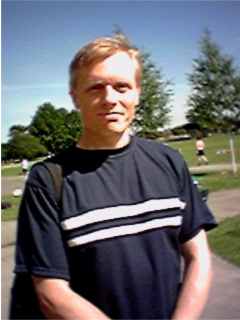
Hi, my name is , I live in Seattle, WA, USA, and I am a self-employed software engineer. I started developing this website in 2001, both as a personal project to learn scientific computing, and with a vision of developing an online science museum. I grew up in Chicago near the Museum of Science and Industry which I loved to visit and learn about science and math.
I got a BA in Mathematics at Oberlin College, Ohio, 1978, and an MBA from Univerity of Chicago, 1984. My first software jobs were using the language APL which I enjoyed for its math-like conciseness and power.
I was fortunate to get involved in the Macintosh software industry early on in 1985, joining MacroMind, which became Macromedia. I led the software development at MacroMind as VP of Engineering for 5 years. Our most significant product was VideoWorks, which was renamed Director, and lives on today as Adobe Director. In the 1980's, the interactive multimedia concepts that are so common today were new and being developed. VideoWorks was mainly an animation tool, but also incorporated programmable interactivity. Our main competitors at that time were HyperCard, SuperCard, and Authorware. Director was used in many different ways; I am most proud that it became the preferred way to prototype software user interfaces for a time during the 90's. Director was also used to develop the introductory "guided tour" tutorial that came with the Macintosh in the early years. And of course, Director was used for all sorts of art, design, and marketing projects.
I went on to work at Apple Computer on new multimedia and user interface concepts involving digital agents, animated user interfaces, speech recognition and distributed information access. In 1991, there was a sudden flurry of activity when Apple and IBM were trying to set up a strategic partnership. I became involved in the super-secret negotiations, and made the suggestion that what the world needed was a standard for multimedia that multimedia content creators could rely on to publish to (ultimately this is what HTML became). Based on these suggestions, Kaleida Labs was founded. Our work there developed a product called ScriptX, which turned out to be very similar to Sun's Java which was being developed at the same time. ScriptX had goals of supporting all forms of multimedia: text, images, audio, video, animation; being cross-platform (Mac and Windows), interpreted, object oriented, with a garbage collector to manage memory.
I then moved to Seattle and turned my attention back to mathematics and science. I relearned calculus by doing all the problems in my old college text book and took further math classes at the University of Washington. I started developing this website as a way to practice what I was learning. I am now happy to use excellent tools such as HTML and JavaScript, and leave their development to others. I continue to work on physics simulations, with several new ones in development.
Archive of older projects.
This web page was first published April 2001.