Peter's electronic projects Peter's electronic projects
Navigate to the or Tools menu (depending on your current UI version). Select Upgrade By USB .
Copy the downloaded 2013 firmware file directly to the root directory of the USB drive (do not put it inside a folder). Step 2: Connect to the Receiver
What exact (e.g., blinking red light, freezing menus) your device is currently showing?
Connect your receiver to a stable power source. A sudden power outage midway through the flashing process can permanently corrupt the flash memory. Step-by-Step Installation Guide via USB
with the 2013 firmware is essential for any user looking to maximize the reliability of their HDMI connection and PVR features. This update, while dating back to 2013, remains crucial for ensuring the longevity and stable performance of this popular receiver. iclass+9898+xs+pvr+hdmi+upgrade+2013
iclass+9898+xs+pvr+hdmi+upgrade+2013 , Satellite receiver firmware, FTA box history, ALi chipset.
[Format USB Drive to FAT32] ➔ [Extract 2013 .bin File] ➔ [Insert Into Receiver] ➔ [Run Update via System Menu]
has long been a stalwart in the satellite receiver market, prized for its robust performance, Personal Video Recording (PVR) capabilities, and, crucially, its HDMI connectivity . However, to maintain optimal performance, especially when utilizing high-definition displays, keeping the software updated is essential. In 2013, several critical firmware updates were released to enhance the stability of the and improve the recording functionality.
In 2013, iClass released a series of firmware updates that addressed several hardware limitations and software bugs. For the model, this specific update cycle was designed to: Navigate to the or Tools menu (depending on
Are you currently facing a specific or bug on your device?
Software updates released during 2013 typically addressed several performance factors:
Full 1080i/720p HD capability via HDMI output.
Older builds suffered from linear degradation of audio syncing over long viewing sessions when connected via the HDMI port. The 2013 patch permanently resolves this digital handshake lag. Step 2: Connect to the Receiver What exact (e
: Allows users to record live television directly to external storage devices via USB.
: Allows users to record live television directly onto an external USB flash drive or hard drive.
Date: April 23, 2026
Using a USB thumb drive is the easiest method to apply the 2013 update without specialized electronic equipment. Phase 1: Preparing the Media
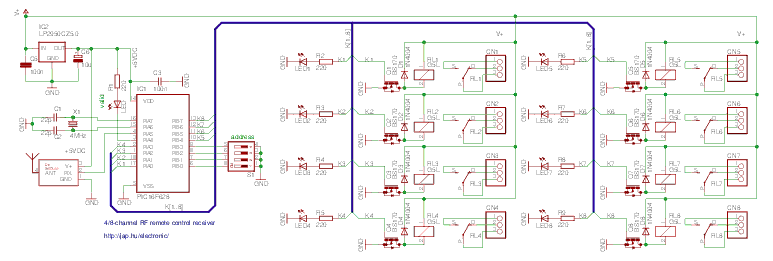
 Try it now, before building! Click on the transmitter buttons with the
green
labels
on the left and see how the receiver outputs (K1-K8) change. Change
the number of transmitter or receiver channels. Switch the receiver
output type between latched and momentary.
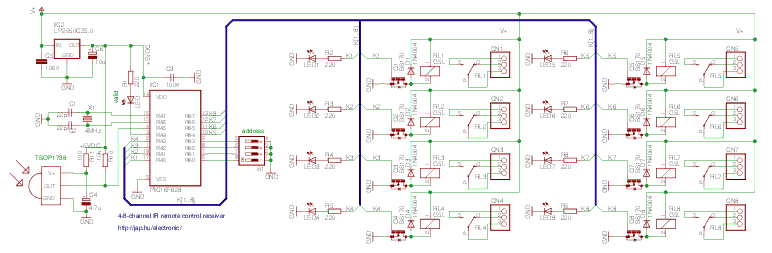
Try it now, before building! Click on the transmitter buttons with the
green
labels
on the left and see how the receiver outputs (K1-K8) change. Change
the number of transmitter or receiver channels. Switch the receiver
output type between latched and momentary.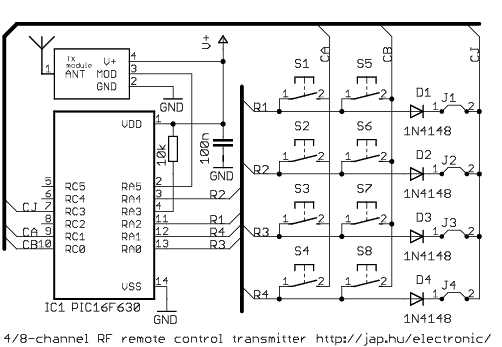
| part | description |
| C1 |
100nF ceramic capacitor |
| R1 |
10k resistor (1/8W) |
| D1-D4 | 1N4148 diode (optional) |
| S1-S8 |
tact switch, DTSM 61N or similar |
| IC1 | PIC16F630 or PIC16F676 microcontroller, pre-programmed |
| TXMOD |
radio
transmitter module, see text (hardware) |
| B1 |
battery between 2-5.5VDC (check TXMOD specs for valid voltage range) |
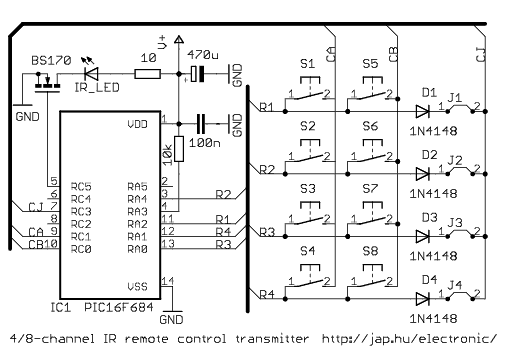
| part | description |
| C1 |
100nF ceramic capacitor |
| C2 |
470 uF 6.3V, electrolytic
capacitor |
| R1 |
10k resistor (1/8W) |
| R2 |
10 ohm resistor (1/4W) |
| D1-D4 | 1N4148 diode (optional) |
| D5 |
IR transmitter LED |
| Q1 |
BSS138 or similar N-MOSFET |
| S1-S8 |
tact switch, DTSM 61N or similar |
| IC1 | PIC16F684 microcontroller, pre-programmed |
| B1 |
battery between 2-5.5VDC (CR2032, 3.6V LiIon battery or 3xAA
batteries) |
| please
observe the corresponding address configuration! |
|
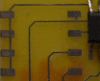 transmitter: no diodes connected |
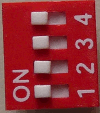 receiver: switches all ON |
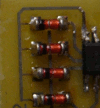 transmitter: all diodes connected |
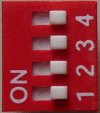 receiver: switches all OFF |
parts list
| part | description |
| C1, C2 | 22pF ceramic capacitor |
| C3, C5 | 100nF ceramic capacitor |
| C6 | 10uF 6.3V electrolytic capacitor |
| CN1-CN8 | PCB terminal block, 3-way (DG301) |
| D1-D8 | 1N4004 diode |
| IC1 | PIC16F627 or PIC16F628 or PIC16F627A or PIC16F628A microcontroller, pre-programmed |
| IC2 | LP2950CZ5.0 voltage regulator |
| LED | 3mm LED (green) |
| LED1-LED8 | 3mm LED (red) |
| Q1-Q8 | BS170 N-channel mosfet transistor |
| R1-R9 | 220R resistor (1/8W) |
| RL1-RL8 | G5LE relay, see text for coil voltage selection |
| S1 | piano DIP switch, 4-way |
| X1 | 4MHz HC49 crystal |
| RXMOD | 3-pin radio receiver module, see text (hardware) |
| please
observe the corresponding address configuration! |
|
| transmitter: no diodes connected |
receiver: switches all ON |
| transmitter: all diodes connected |
receiver: switches all OFF |
Navigate to the or Tools menu (depending on your current UI version). Select Upgrade By USB .
Copy the downloaded 2013 firmware file directly to the root directory of the USB drive (do not put it inside a folder). Step 2: Connect to the Receiver
What exact (e.g., blinking red light, freezing menus) your device is currently showing?
Connect your receiver to a stable power source. A sudden power outage midway through the flashing process can permanently corrupt the flash memory. Step-by-Step Installation Guide via USB
with the 2013 firmware is essential for any user looking to maximize the reliability of their HDMI connection and PVR features. This update, while dating back to 2013, remains crucial for ensuring the longevity and stable performance of this popular receiver.
iclass+9898+xs+pvr+hdmi+upgrade+2013 , Satellite receiver firmware, FTA box history, ALi chipset.
[Format USB Drive to FAT32] ➔ [Extract 2013 .bin File] ➔ [Insert Into Receiver] ➔ [Run Update via System Menu]
has long been a stalwart in the satellite receiver market, prized for its robust performance, Personal Video Recording (PVR) capabilities, and, crucially, its HDMI connectivity . However, to maintain optimal performance, especially when utilizing high-definition displays, keeping the software updated is essential. In 2013, several critical firmware updates were released to enhance the stability of the and improve the recording functionality.
In 2013, iClass released a series of firmware updates that addressed several hardware limitations and software bugs. For the model, this specific update cycle was designed to:
Are you currently facing a specific or bug on your device?
Software updates released during 2013 typically addressed several performance factors:
Full 1080i/720p HD capability via HDMI output.
Older builds suffered from linear degradation of audio syncing over long viewing sessions when connected via the HDMI port. The 2013 patch permanently resolves this digital handshake lag.
: Allows users to record live television directly to external storage devices via USB.
: Allows users to record live television directly onto an external USB flash drive or hard drive.
Date: April 23, 2026
Using a USB thumb drive is the easiest method to apply the 2013 update without specialized electronic equipment. Phase 1: Preparing the Media
LATCH_MASK EQU B'00001111' sets channels 8-5 to momentary
and
channels 4-1 to latched (toggle) mode. Then use the compiler (MPLAB or
gputils) to
assemble the code.clrf
0x91 ;
ANSEL