
Click on one of the physics simulations below... you'll see them animating in real time, and be able to interact with them by dragging objects or changing parameters like gravity.
For general technical guides on legacy PC games, PCGamingWiki is an excellent resource for fixing modern OS compatibility issues.
Restore your career after a computer crash or reinstallation.
Here’s a quick reference for where to find saves for other titles, which often works for both original and "no-DRM" (Pirated/Repack) versions:
Warning: downloading or running files from unknown sources can risk malware or game corruption. Only use files from trusted communities and scan with antivirus before opening. motogp 2 save game files pc free
Including legendary names like Valentino Rossi, Max Biaggi, and Tohru Ukawa.
If you need help troubleshooting or want to locate specific files, let me know: What are you running?
MotoGP 2 (also known as MotoGP Ultimate Racing Technology 2 ), released back in 2003, remains a cult classic for motorcycle racing fans on PC. It’s remembered for its challenging, fast-paced arcade-simulation hybrid gameplay, iconic rider roster, and legendary tracks from that era. For general technical guides on legacy PC games,
The default directory for MotoGP 2 save data is usually within the game's installation folder. Path: C:\Program Files\THQ\MotoGP 2\save\
If you prefer downloading a pre-completed save file to skip progression:
MotoGP 2 might be old enough to vote, but its save system is a beautiful relic from a time when games trusted you to look under the hood. With a simple text editor and five minutes of your time, you can turn the game into a sandbox of 990cc chaos. Only use files from trusted communities and scan
While focusing on technical fixes, the community discussions often provide links to saves, or at least detail the exact path to locate your existing saves to backup.
C:\Users\[Your-Username]\AppData\Local\VirtualStore\Program Files (x86)\THQ\MotoGP 2\ Step 2: Backup Your Existing Progress Before changing any files, protect your current progress. Right-click your existing Saves folder. Select Copy . Paste it onto your Desktop as a temporary backup. Step 3: Replace the Save Files
Save files are usually named *.sav or MotoGP2.sav .
Communities dedicated to retro PC gaming often retain archived threads containing original profile folders.
There are several ways to reproduce a particular experimental setup. The easiest way is to click the "share" button.
When the recipient clicks the URL, the EasyScript that is embedded in the URL will replicate the conditions that you set up.
See Customizing myPhysicsLab Simulations for how to customize further with JavaScript or EasyScript.
myPhysicsLab is provided as open source software under the Apache 2.0 License. Source code is available at https://github.com/myphysicslab/myphysicslab. Online documentation is available.
There are around 50 different simulations in the source code, each of which has an example file which is for development and testing. There are also downloadable versions which be used to show simulations offline (when not connected to the internet).
Most of the simulation web pages show how the math is derived. See for example the Single Spring simulation.
The rigid body physics engine is the most sophisticated simulation shown here. It is capable of replicating all of the other more specialized simulations. The physics engine handles collisions and also calculates contact forces which allow objects to push against each other.
See also links to other physics websites.
The myPhysicsLab simulations do not have units of measurements specified such as meters, kilograms, seconds. The units are dimensionless, they can be interpreted however you want, but they must be consistent within the simulation.
For example if we regard a unit of distance as one meter and a unit of time as one second, then a unit of velocity must be one meter/second.
See the discussion About Units Of Measurement in the myPhysicsLab Documentation.
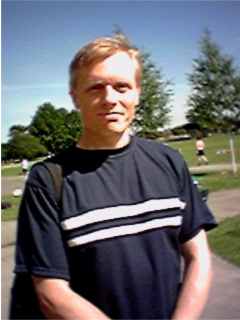
Hi, my name is , I live in Seattle, WA, USA, and I am a self-employed software engineer. I started developing this website in 2001, both as a personal project to learn scientific computing, and with a vision of developing an online science museum. I grew up in Chicago near the Museum of Science and Industry which I loved to visit and learn about science and math.
I got a BA in Mathematics at Oberlin College, Ohio, 1978, and an MBA from Univerity of Chicago, 1984. My first software jobs were using the language APL which I enjoyed for its math-like conciseness and power.
I was fortunate to get involved in the Macintosh software industry early on in 1985, joining MacroMind, which became Macromedia. I led the software development at MacroMind as VP of Engineering for 5 years. Our most significant product was VideoWorks, which was renamed Director, and lives on today as Adobe Director. In the 1980's, the interactive multimedia concepts that are so common today were new and being developed. VideoWorks was mainly an animation tool, but also incorporated programmable interactivity. Our main competitors at that time were HyperCard, SuperCard, and Authorware. Director was used in many different ways; I am most proud that it became the preferred way to prototype software user interfaces for a time during the 90's. Director was also used to develop the introductory "guided tour" tutorial that came with the Macintosh in the early years. And of course, Director was used for all sorts of art, design, and marketing projects.
I went on to work at Apple Computer on new multimedia and user interface concepts involving digital agents, animated user interfaces, speech recognition and distributed information access. In 1991, there was a sudden flurry of activity when Apple and IBM were trying to set up a strategic partnership. I became involved in the super-secret negotiations, and made the suggestion that what the world needed was a standard for multimedia that multimedia content creators could rely on to publish to (ultimately this is what HTML became). Based on these suggestions, Kaleida Labs was founded. Our work there developed a product called ScriptX, which turned out to be very similar to Sun's Java which was being developed at the same time. ScriptX had goals of supporting all forms of multimedia: text, images, audio, video, animation; being cross-platform (Mac and Windows), interpreted, object oriented, with a garbage collector to manage memory.
I then moved to Seattle and turned my attention back to mathematics and science. I relearned calculus by doing all the problems in my old college text book and took further math classes at the University of Washington. I started developing this website as a way to practice what I was learning. I am now happy to use excellent tools such as HTML and JavaScript, and leave their development to others. I continue to work on physics simulations, with several new ones in development.
Archive of older projects.
This web page was first published April 2001.